


Flight in the Stinson L-5 of the Swiss Air Force
An agile light aircraft, excellent all-around visibility, and genuine military history: The Stinson L-5 Sentinel is one of the most distinctive liaison and observation aircraft of the Second World War. It was primarily used for reconnaissance, courier, and transport missions and impressed with its exceptional short takeoff and low-speed flight characteristics. Today's HB-TRY also boasts a special Swiss past: After an emergency landing in Switzerland during the Second World War, it was later used by the Swiss Air Force as the A-96.
A flight in the HB-TRY is far more than an ordinary sightseeing flight. From Grenchen airfield, you'll experience the Swiss Plateau, the Jura Mountains, and, depending on the flight duration, even the Pre-Alps from an extraordinary perspective. The generous windows offer excellent views and allow you to experience the unique character of this historic aircraft firsthand.
Flight characteristics of the Stinson L-5
5 reasons for your L-5 flight in Grenchen
Flying in a classic
The Stinson L-5 Sentinel is one of the most distinctive light liaison and observation aircraft of the Second World War. Used for reconnaissance, courier, and transport missions, it was particularly renowned for its excellent short takeoff and low-speed flight characteristics. Today's HB-TRY also boasts a unique Swiss history: after a forced landing in Switzerland during the Second World War, it was later used by the Swiss Air Force as the A-96. Fly in one of the few remaining airworthy former Swiss Air Force aircraft from the Second World War era and experience the exceptional panoramic views, the direct feel of flight, and the unique character of this historic classic firsthand!
Powerful sound & warbird feeling
The distinctive sound of the Lycoming engine, the excellent all-around visibility, and the immediate feeling of flight make a flight in the Stinson L-5 Sentinel a truly special experience. In this historic liaison aircraft, you'll experience 1940s aviation up close – authentic, original, and with a unique character all its own.
Accordion Panel
Whether a leisurely scenic flight or a more dynamic flying experience with steeper turns to directly experience the unique feeling of flying the Stinson L-5: The flight can be individually tailored to your wishes, your personal well-being and the respective flight conditions, within the scope of possibilities.
Breathtaking landscape
Whether a leisurely scenic flight over the Jura Mountains and the Three Lakes Region or a more extensive flight towards the Pre-Alps and Alps: the route can be individually tailored to your wishes, within the available options. Experience the diverse Swiss landscape from the exceptional perspective of the Stinson L-5. Choose between a completely relaxed and enjoyable flight or more dynamic maneuvers to experience the direct feel of flying this historic classic.
Personal care & unforgettable memories
Experienced pilots, personalized arrangements, and genuine passion make your flight not only safe and personal, but also bring you closer to a piece of Swiss Air Force history. Every minute on board brings the atmosphere of a historic liaison aircraft from the Second World War to life, making the flight a truly special experience.
The Stinson L-5 Sentinel is one of the most distinctive light liaison and observation aircraft of the Second World War. Used for reconnaissance, courier, and transport missions, it was particularly renowned for its excellent short takeoff and low-speed flight characteristics. Today's HB-TRY also boasts a unique Swiss history: after a forced landing in Switzerland during the Second World War, it was later used by the Swiss Air Force as the A-96. Fly in one of the few remaining airworthy former Swiss Air Force aircraft from the Second World War era and experience the exceptional panoramic views, the direct feel of flight, and the unique character of this historic classic firsthand!
The distinctive sound of the Lycoming engine, the excellent all-around visibility, and the immediate feeling of flight make a flight in the Stinson L-5 Sentinel a truly special experience. In this historic liaison aircraft, you'll experience 1940s aviation up close – authentic, original, and with a unique character all its own.
Whether a leisurely scenic flight or a more dynamic flying experience with steeper turns to directly experience the unique feeling of flying the Stinson L-5: The flight can be individually tailored to your wishes, your personal well-being and the respective flight conditions, within the scope of possibilities.
Whether a leisurely scenic flight over the Jura Mountains and the Three Lakes Region or a more extensive flight towards the Pre-Alps and Alps: the route can be individually tailored to your wishes, within the available options. Experience the diverse Swiss landscape from the exceptional perspective of the Stinson L-5. Choose between a completely relaxed and enjoyable flight or more dynamic maneuvers to experience the direct feel of flying this historic classic.
Experienced pilots, personalized arrangements, and genuine passion make your flight not only safe and personal, but also bring you closer to a piece of Swiss Air Force history. Every minute on board brings the atmosphere of a historic liaison aircraft from the Second World War to life, making the flight a truly special experience.
Customer voice

The sound of the engine is simply amazing! It was a lot of fun.
Questions & Answers about the Mustang Flight
When do flights take place?
Flights with the Stinson L-5 Sentinel are generally possible year-round and by individual arrangement. Suitable weather conditions and the availability of the aircraft and pilot are prerequisites.
Where are we flying to?
Flights with the Stinson L-5 Sentinel are generally possible year-round and by individual arrangement. Suitable weather conditions and the availability of the aircraft and pilot are prerequisites.
What is the process?
At Grenchen airfield, you will be personally greeted by your experienced pilot and get to know the historic Stinson L-5 Sentinel HB-TRY up close. During a detailed briefing, you will learn interesting facts about the aircraft, its unique history, and its time with the Swiss Air Force. Together, you will then discuss your desired flight route and the flight plan. Afterwards, you will take your seat in the cockpit and embark on your personal flying experience over the Jura Mountains, the Three Lakes Region, or, if you wish, towards the Pre-Alps and Alps. After landing, there will be plenty of time for photos, questions, and a personal chat with the pilot.
How long does it take in total?
In addition to your chosen flight duration, please allow approximately 1 to 1.5 hours for the entire experience. Besides the briefing, flight preparation, and the actual flight in the Stinson L-5 Sentinel, there will be ample time for photos, questions, and personal conversations with the pilot.
Is aerobatics flown with the Stinson L-5 Sentinel?
Aerobatics are not possible with the Stinson L-5 Sentinel. However, upon request, the flight can be made more dynamic, for example with steeper turns, to experience the direct and authentic flying feel of the Stinson more intensely. The experienced pilot will tailor the flight to your individual wishes, your personal comfort, and the prevailing flying conditions.
Can friends or family come to the airfield?
Of course! Your companions are very welcome at Grenchen airfield and can witness the flight preparation, takeoff, and landing. During your flight in the Stinson L-5 Sentinel, they can observe the activity at the airfield, take photos, or enjoy a drink or a meal in the airfield restaurant.
Can I take photos or videos?
Of course! Photos and videos may be taken free of charge before and after the flight.
Who is my pilot?
Your flight will be conducted by an experienced pilot who knows the Stinson L-5 and its unique flight characteristics inside and out. Depending on the date, you will fly with Christoph Dubler, a professional pilot with many years of experience flying the HB-TRY and a captain on the Antonov An-2. Alternatively, you will fly with Niko Koch, a flight instructor with approximately 900 flight hours and experience on the Stinson L-5, the Antonov An-2, and various tailwheel aircraft. He also holds a glider pilot's license. This ensures you are in expert hands throughout the entire experience and will learn fascinating details about the aircraft and its history.
What is the story behind HB-TRY?
The Stinson L-5B Sentinel HB-TRY, as it is known today, was built in the USA in 1944 and taken over by the United States Army Air Forces on March 9th of that year. Shortly thereafter, it was shipped to Europe and used by various American air forces.
On October 12, 1944, the extraordinary Swiss chapter of their history began. During a reconnaissance flight with the 324th Fighter Group, Lieutenant Roy G. Abbott and his passenger inadvertently crossed the Swiss border in very poor visibility. The aircraft was fired upon and damaged by Swiss anti-aircraft fire. Abbott was forced to make an emergency landing in the Stinson near Les Vacheries-des-Genevez in the western Jura Mountains. The crew was interned, and the aircraft was taken to Dübendorf.
After the end of the Second World War, the L-5 was transferred to the Swiss Air Force. From October 1945, it flew there under the military registration A-96 and bore the neutrality markings characteristic of that period. Thus, the present-day HB-TRY is one of the few remaining and still airworthy former aircraft of the Swiss Air Force from the Second World War era.
In 1950, the aircraft was sold to ALPAR in Bern and received its civilian registration HB-TRY. In the following years, it was used, among other things, for gliding operations in Thun, before being removed from the Swiss aircraft register at the end of 1968. Subsequently, it spent several years on the ground and was even temporarily displayed at a restaurant between Beromünster and Sursee.
In 1979, the Dubler family purchased the historic Stinson, thus saving it from being lost forever. Many years later, a comprehensive restoration began. In 2006, the L-5 finally took to the skies again, once more in its original color scheme and with its former Swiss military registration A-96.
Today, the HB-TRY is based at Grenchen Regional Airport, offering passengers a direct encounter with Swiss aviation history. From its service during the Second World War and with the Swiss Air Force to its extensive restoration, this Stinson aircraft looks back on an extraordinary history spanning more than eight decades.
Can I learn more about the North American T-6?
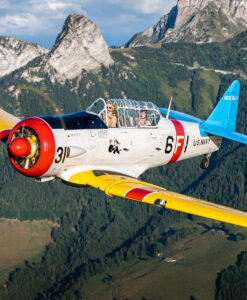
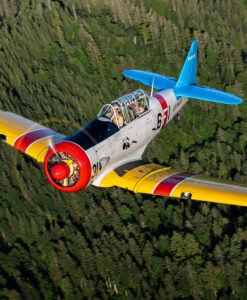
The North American T-6 Texan is one of the best-known and most important training aircraft of World War II. Its development began in the 1930s. As a so-called "Advanced Trainer," it was used to prepare aspiring military pilots for the transition to high-performance fighter aircraft after basic training.
The T-6 formed the crucial link between simple training aircraft and the operational planes of the time. Its retractable landing gear, adjustable propeller, and sophisticated flight characteristics already instilled in pilots many of the features of a fighter aircraft. Thanks to the two tandem seats, the flight instructor could accompany the student throughout the entire training.
The T-6 is powered by an air-cooled Pratt & Whitney nine-cylinder radial engine producing around 600 hp. The powerful engine, the direct control feel, and the characteristic sound give the aircraft its unmistakable warbird character.
Operating the aircraft also required concentration and a good understanding of the interplay between engine power, propeller pitch, fuel mixture, landing gear, and flaps. It is precisely this combination of sophisticated technology, historical character, and impressive flight characteristics that makes flying the North American T-6 a unique experience even today.
What is the story behind this Stinson?
The Stinson L-5B Sentinel HB-TRY, as it is known today, was built in the USA in 1944 and acquired by the United States Army Air Forces. Later that same year, it was brought to Europe and used for military liaison and reconnaissance missions.
On October 12, 1944, its story took an extraordinary turn. During a reconnaissance flight, the aircraft unintentionally entered Swiss airspace in poor visibility, was damaged by Swiss anti-aircraft fire, and had to make an emergency landing in the western Jura Mountains. After the war, it was acquired by the Swiss Air Force and used as A-96.
Its civilian career began in 1950 under the registration HB-TRY, which it still bears today. After various postings in Switzerland, the aircraft was decommissioned at the end of the 1960s. In 1979, the Dubler family acquired the historic aircraft and preserved it for posterity. Following extensive restoration, the Stinson took to the skies again in 2006 and has since been presented in the historical livery of its time with the Swiss Air Force.
Today, the HB-TRY is based in Grenchen and is one of the few remaining airworthy former aircraft of the Swiss Air Force from the Second World War. Thanks to meticulous maintenance, passengers can once again experience this extraordinary piece of Swiss aviation history where it belongs: in the air.
We are proud to offer this special aircraft for passenger flights. Whether on a relaxing flight over the Jura Mountains and the Three Lakes Region or on a longer route towards the Pre-Alps and Alps, the Stinson offers an authentic flying experience and an exceptional perspective on the Swiss landscape.
Tell me more about the manufacturer Stinson
The Stinson Aircraft Company was among the most prominent American aircraft manufacturers of the first half of the 20th century. The company was founded in 1920 by aviation pioneer Edward "Eddie" Stinson, one of the early American pilots and aircraft designers. In the following decades, numerous touring, commercial, and military aircraft were produced under the Stinson name.
Stinson became particularly well-known for its robust and docile aircraft, which were also suitable for operating from smaller airfields. An important civilian model series was the Stinson Model 105, from whose development line the military L-5 Sentinel later emerged. In 1940, Stinson became part of the Vultee Aircraft Corporation, under whose leadership the development of military aircraft types was further advanced.
During World War II, the Stinson L-5 Sentinel became one of the most important light liaison aircraft of the American armed forces. Specifically designed for military requirements, the aircraft was characterized by its robust construction, excellent low-speed flight characteristics, and very short takeoff and landing distances. Due to its versatility, it earned the nickname "Flying Jeep.".
The L-5 was used for an exceptionally wide range of tasks. These included reconnaissance and liaison flights, transport of personnel and supplies, observation of artillery targets, and the evacuation of wounded soldiers from areas near the front. Its ability to operate from short and sometimes improvised airstrips made it particularly valuable.
After World War II, the L-5 remained in service with various armed forces for several more years and was also used during the Korean War. At the same time, numerous former military aircraft found their way into civilian aviation.
The HB-TRY is therefore not only a rare historic aircraft, but also a flying testament to the Stinson tradition. Its robust construction, generous glazing, and excellent short takeoff and landing capabilities still clearly demonstrate why the L-5 became such a versatile and highly regarded aircraft during the Second World War.
Flights with the Stinson L-5 Sentinel are generally possible year-round and by individual arrangement. Suitable weather conditions and the availability of the aircraft and pilot are prerequisites.
Flights with the Stinson L-5 Sentinel are generally possible year-round and by individual arrangement. Suitable weather conditions and the availability of the aircraft and pilot are prerequisites.
At Grenchen airfield, you will be personally greeted by your experienced pilot and get to know the historic Stinson L-5 Sentinel HB-TRY up close. During a detailed briefing, you will learn interesting facts about the aircraft, its unique history, and its time with the Swiss Air Force. Together, you will then discuss your desired flight route and the flight plan. Afterwards, you will take your seat in the cockpit and embark on your personal flying experience over the Jura Mountains, the Three Lakes Region, or, if you wish, towards the Pre-Alps and Alps. After landing, there will be plenty of time for photos, questions, and a personal chat with the pilot.
In addition to your chosen flight duration, please allow approximately 1 to 1.5 hours for the entire experience. Besides the briefing, flight preparation, and the actual flight in the Stinson L-5 Sentinel, there will be ample time for photos, questions, and personal conversations with the pilot.
Aerobatics are not possible with the Stinson L-5 Sentinel. However, upon request, the flight can be made more dynamic, for example with steeper turns, to experience the direct and authentic flying feel of the Stinson more intensely. The experienced pilot will tailor the flight to your individual wishes, your personal comfort, and the prevailing flying conditions.
Of course! Your companions are very welcome at Grenchen airfield and can witness the flight preparation, takeoff, and landing. During your flight in the Stinson L-5 Sentinel, they can observe the activity at the airfield, take photos, or enjoy a drink or a meal in the airfield restaurant.
Of course! Photos and videos may be taken free of charge before and after the flight.
Your flight will be conducted by an experienced pilot who knows the Stinson L-5 and its unique flight characteristics inside and out. Depending on the date, you will fly with Christoph Dubler, a professional pilot with many years of experience flying the HB-TRY and a captain on the Antonov An-2. Alternatively, you will fly with Niko Koch, a flight instructor with approximately 900 flight hours and experience on the Stinson L-5, the Antonov An-2, and various tailwheel aircraft. He also holds a glider pilot's license. This ensures you are in expert hands throughout the entire experience and will learn fascinating details about the aircraft and its history.
The Stinson L-5B Sentinel HB-TRY, as it is known today, was built in the USA in 1944 and taken over by the United States Army Air Forces on March 9th of that year. Shortly thereafter, it was shipped to Europe and used by various American air forces.
On October 12, 1944, the extraordinary Swiss chapter of their history began. During a reconnaissance flight with the 324th Fighter Group, Lieutenant Roy G. Abbott and his passenger inadvertently crossed the Swiss border in very poor visibility. The aircraft was fired upon and damaged by Swiss anti-aircraft fire. Abbott was forced to make an emergency landing in the Stinson near Les Vacheries-des-Genevez in the western Jura Mountains. The crew was interned, and the aircraft was taken to Dübendorf.
After the end of the Second World War, the L-5 was transferred to the Swiss Air Force. From October 1945, it flew there under the military registration A-96 and bore the neutrality markings characteristic of that period. Thus, the present-day HB-TRY is one of the few remaining and still airworthy former aircraft of the Swiss Air Force from the Second World War era.
In 1950, the aircraft was sold to ALPAR in Bern and received its civilian registration HB-TRY. In the following years, it was used, among other things, for gliding operations in Thun, before being removed from the Swiss aircraft register at the end of 1968. Subsequently, it spent several years on the ground and was even temporarily displayed at a restaurant between Beromünster and Sursee.
In 1979, the Dubler family purchased the historic Stinson, thus saving it from being lost forever. Many years later, a comprehensive restoration began. In 2006, the L-5 finally took to the skies again, once more in its original color scheme and with its former Swiss military registration A-96.
Today, the HB-TRY is based at Grenchen Regional Airport, offering passengers a direct encounter with Swiss aviation history. From its service during the Second World War and with the Swiss Air Force to its extensive restoration, this Stinson aircraft looks back on an extraordinary history spanning more than eight decades.
The North American T-6 Texan is one of the best-known and most important training aircraft of World War II. Its development began in the 1930s. As a so-called "Advanced Trainer," it was used to prepare aspiring military pilots for the transition to high-performance fighter aircraft after basic training.
The T-6 formed the crucial link between simple training aircraft and the operational planes of the time. Its retractable landing gear, adjustable propeller, and sophisticated flight characteristics already instilled in pilots many of the features of a fighter aircraft. Thanks to the two tandem seats, the flight instructor could accompany the student throughout the entire training.
The T-6 is powered by an air-cooled Pratt & Whitney nine-cylinder radial engine producing around 600 hp. The powerful engine, the direct control feel, and the characteristic sound give the aircraft its unmistakable warbird character.
Operating the aircraft also required concentration and a good understanding of the interplay between engine power, propeller pitch, fuel mixture, landing gear, and flaps. It is precisely this combination of sophisticated technology, historical character, and impressive flight characteristics that makes flying the North American T-6 a unique experience even today.
The Stinson L-5B Sentinel HB-TRY, as it is known today, was built in the USA in 1944 and acquired by the United States Army Air Forces. Later that same year, it was brought to Europe and used for military liaison and reconnaissance missions.
On October 12, 1944, its story took an extraordinary turn. During a reconnaissance flight, the aircraft unintentionally entered Swiss airspace in poor visibility, was damaged by Swiss anti-aircraft fire, and had to make an emergency landing in the western Jura Mountains. After the war, it was acquired by the Swiss Air Force and used as A-96.
Its civilian career began in 1950 under the registration HB-TRY, which it still bears today. After various postings in Switzerland, the aircraft was decommissioned at the end of the 1960s. In 1979, the Dubler family acquired the historic aircraft and preserved it for posterity. Following extensive restoration, the Stinson took to the skies again in 2006 and has since been presented in the historical livery of its time with the Swiss Air Force.
Today, the HB-TRY is based in Grenchen and is one of the few remaining airworthy former aircraft of the Swiss Air Force from the Second World War. Thanks to meticulous maintenance, passengers can once again experience this extraordinary piece of Swiss aviation history where it belongs: in the air.
We are proud to offer this special aircraft for passenger flights. Whether on a relaxing flight over the Jura Mountains and the Three Lakes Region or on a longer route towards the Pre-Alps and Alps, the Stinson offers an authentic flying experience and an exceptional perspective on the Swiss landscape.
The Stinson Aircraft Company was among the most prominent American aircraft manufacturers of the first half of the 20th century. The company was founded in 1920 by aviation pioneer Edward "Eddie" Stinson, one of the early American pilots and aircraft designers. In the following decades, numerous touring, commercial, and military aircraft were produced under the Stinson name.
Stinson became particularly well-known for its robust and docile aircraft, which were also suitable for operating from smaller airfields. An important civilian model series was the Stinson Model 105, from whose development line the military L-5 Sentinel later emerged. In 1940, Stinson became part of the Vultee Aircraft Corporation, under whose leadership the development of military aircraft types was further advanced.
During World War II, the Stinson L-5 Sentinel became one of the most important light liaison aircraft of the American armed forces. Specifically designed for military requirements, the aircraft was characterized by its robust construction, excellent low-speed flight characteristics, and very short takeoff and landing distances. Due to its versatility, it earned the nickname "Flying Jeep.".
The L-5 was used for an exceptionally wide range of tasks. These included reconnaissance and liaison flights, transport of personnel and supplies, observation of artillery targets, and the evacuation of wounded soldiers from areas near the front. Its ability to operate from short and sometimes improvised airstrips made it particularly valuable.
After World War II, the L-5 remained in service with various armed forces for several more years and was also used during the Korean War. At the same time, numerous former military aircraft found their way into civilian aviation.
The HB-TRY is therefore not only a rare historic aircraft, but also a flying testament to the Stinson tradition. Its robust construction, generous glazing, and excellent short takeoff and landing capabilities still clearly demonstrate why the L-5 became such a versatile and highly regarded aircraft during the Second World War.
More customer testimonials
Clearly the best way to spend a Sunday afternoon. Now let's move on to the Mustang!
Absolutely breathtaking! I felt like a bird flying over the Alps.

I always knew this was Pierre's dream. Thank you for making this possible!
Related products


Bremgarten
acrobatics


Habsheim

Biplane


Highlights