



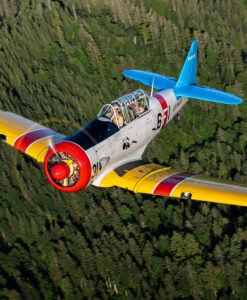


North American T-6G Texan
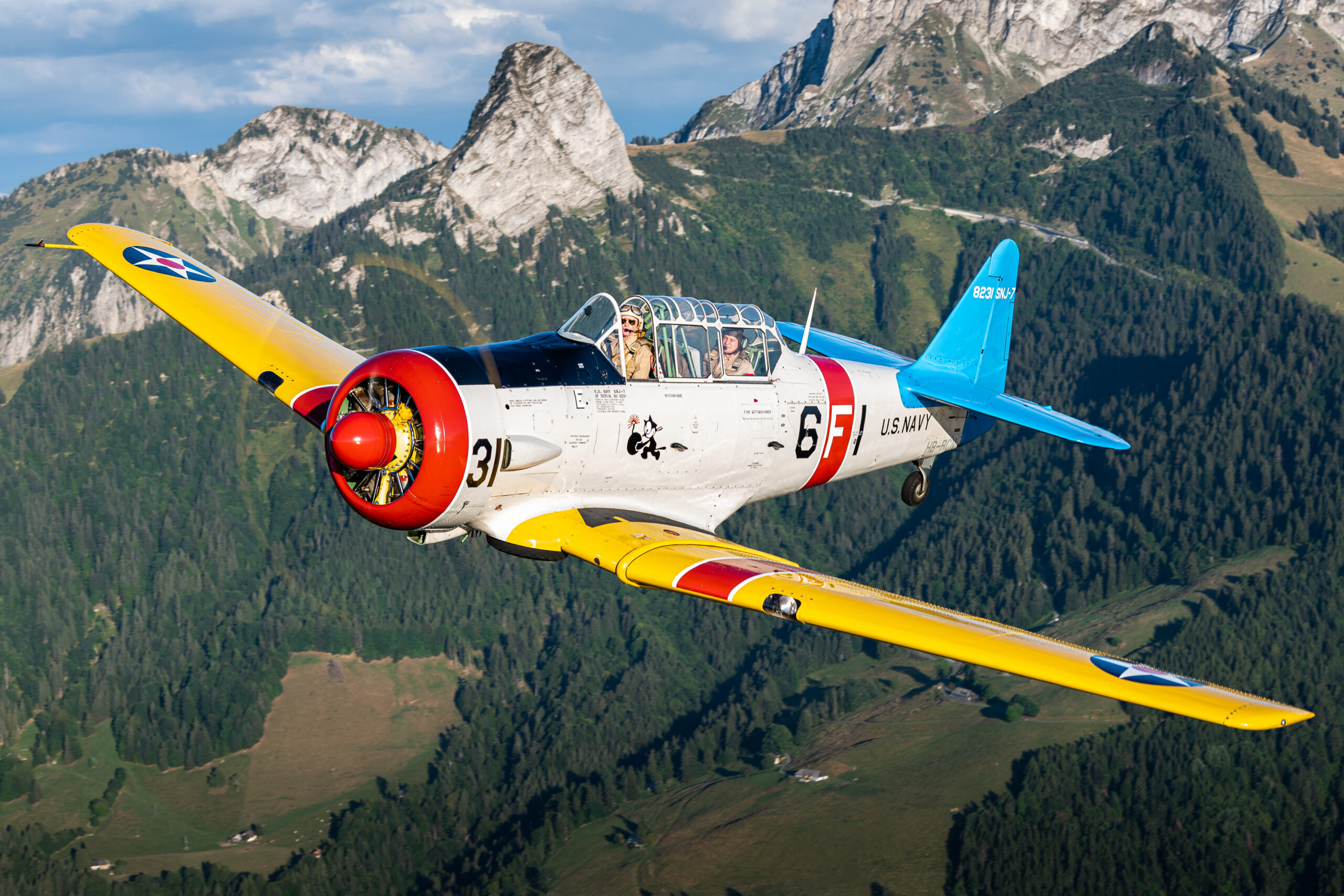
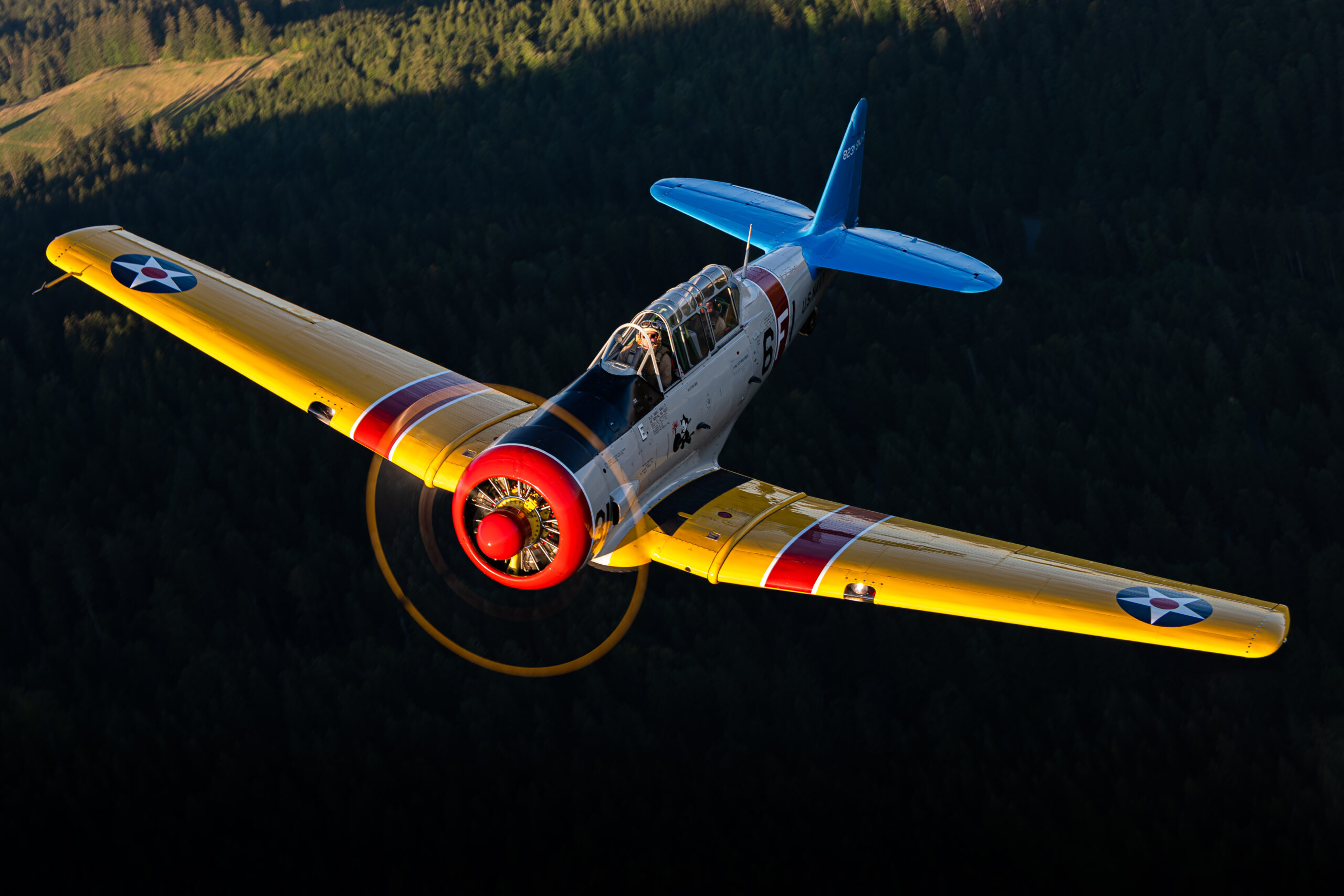
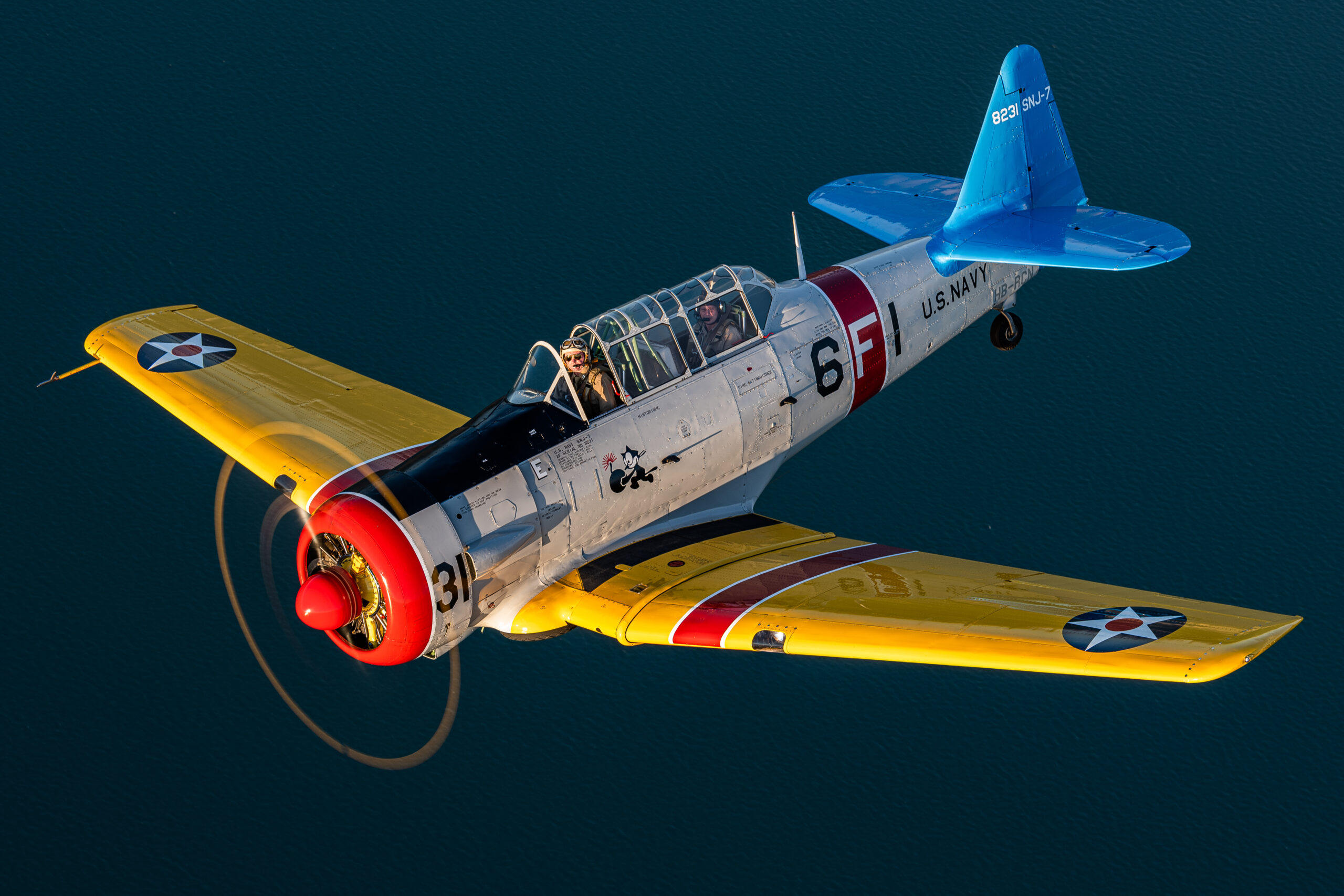
A powerful radial engine, elegant lines, and unmistakable warbird feel: The North American T-6G Texan is one of the most famous training aircraft of World War II. As a so-called "Advanced Trainer," it prepared aspiring military pilots for the transition to high-performance fighter aircraft.
A flight in the HB-RCN is far more than an ordinary sightseeing flight. From Lausanne airfield, you'll experience Lake Geneva, western Switzerland, and, depending on the flight duration, the Alps or the Gruyères region from an extraordinary perspective. You'll feel the power of the approximately 600 hp radial engine and the unique character of this legendary warbird firsthand.
Flight characteristics North American T-6 Texan
5 reasons for your T-6 flight in Lausanne
Flying in a true legend
The North American AT-6 Texan is one of the most famous training aircraft of World War II. As an "Advanced Trainer," it prepared aspiring military pilots for the transition to high-performance fighter aircraft like the P-51 Mustang or the Supermarine Spitfire. Its distinctive radial engine, robust construction, and sophisticated flight characteristics made it one of the most important training aircraft in aviation history. Climb aboard and experience the sound, power, and character of this flying legend up close!
Powerful sound & warbird feeling
The unmistakable sound of the powerful radial engine, the palpable power during acceleration and the direct feeling of flight: In the North American T-6 Texan you experience the fascination of a legendary warbird with all your senses.
You decide how wild it gets
From relaxed sightseeing flights to dynamic flight maneuvers such as loops and rolls, the experience can be individually tailored to your wishes, your personal well-being and the respective flight conditions.
Breathtaking scenery
Taking off from Lausanne offers breathtaking views of Lake Geneva, the surrounding vineyards, and the impressive mountains of western Switzerland. Depending on the chosen flight duration, the route leads either to the Alps or the Gruyères region. This combines the unique flying experience of the T-6 Texan with equally stunning scenery.
Personal care & unforgettable memories
Experienced pilots, individual arrangements, and genuine passion make your flight not only safe and personal, but also an impressive encounter with the history of the North American T-6 Texan. Every minute on board brings to life the fascination of one of the most famous training aircraft of World War II.
The North American AT-6 Texan is one of the most famous training aircraft of World War II. As an "Advanced Trainer," it prepared aspiring military pilots for the transition to high-performance fighter aircraft like the P-51 Mustang or the Supermarine Spitfire. Its distinctive radial engine, robust construction, and sophisticated flight characteristics made it one of the most important training aircraft in aviation history. Climb aboard and experience the sound, power, and character of this flying legend up close!
The unmistakable sound of the powerful radial engine, the palpable power during acceleration and the direct feeling of flight: In the North American T-6 Texan you experience the fascination of a legendary warbird with all your senses.
From relaxed sightseeing flights to dynamic flight maneuvers such as loops and rolls, the experience can be individually tailored to your wishes, your personal well-being and the respective flight conditions.
Taking off from Lausanne offers breathtaking views of Lake Geneva, the surrounding vineyards, and the impressive mountains of western Switzerland. Depending on the chosen flight duration, the route leads either to the Alps or the Gruyères region. This combines the unique flying experience of the T-6 Texan with equally stunning scenery.
Experienced pilots, individual arrangements, and genuine passion make your flight not only safe and personal, but also an impressive encounter with the history of the North American T-6 Texan. Every minute on board brings to life the fascination of one of the most famous training aircraft of World War II.
Customer voice

The sound of the engine is simply amazing! It was a lot of fun.
Questions & Answers about the Mustang Flight
When do flights take place?
Flights with the T-6 Texan generally take place from April to October and by individual arrangement. The exact start of the season depends on the completion of the annual inspection. Flights are generally not possible during the winter months.
Where are we flying to?
Depending on the chosen flight duration, the route takes you over the Lausanne region and Lake Geneva, all the way to the Alps or the Gruyères region. Longer flights expand the area of operation accordingly, allowing you to experience even more of the impressive landscape of western Switzerland.
What is the process?
You will first be greeted at Lausanne Airport by an experienced pilot and get a close look at the impressive T-6G Texan HB-RCN. Afterwards, you will receive a detailed briefing, discuss your personal flight program, and learn more about the history of this legendary training aircraft. Then you will be prepared for the flight. Once the radial engine is warmed up, you will take to the air. After landing, there will be plenty of time for photos, personal conversations with the pilot, and a relaxing end to the day.
How long does it take in total?
In addition to your chosen flight duration, please allow approximately 1 to 1.5 hours for the entire experience. Besides the briefing, flight preparation, and the actual flight in the T-6 Texan, there will be ample time for photos and personal conversations with the pilot.
Is aerobatics flown with the T6?
Depending on the chosen flight duration, simple aerobatic maneuvers such as rolls and loops are also possible. Your highly experienced T-6 pilot will create a customized flight program, taking your wishes into account and ensuring that your flight in the T-6G Texan HB-RCN becomes an unforgettable experience.
Can friends or family come to the airfield?
Of course! Your companions are very welcome at the airfield and can witness the flight preparation, briefing, takeoff, and landing. During your flight in the T-6 Texan, they can observe the activity at the airfield, take photos, or enjoy a drink or a meal in the airfield restaurant.
Can I take photos or videos?
Of course! Photos and videos may be taken free of charge before and after the flight.
Who is my pilot?
Your pilot is Erich Girardet, a highly experienced professional pilot and captain on the Boeing 747. With more than 17,000 flight hours and extensive experience on historic aircraft, including the P-51 Mustang, he brings the best qualifications for a safe and unforgettable flight experience.
The flight program is individually tailored to the chosen flight duration, the weather conditions and your personal wishes.
What is the story behind HB-RCN?
The T-6G Texan HB-RCN, as it is known today, was built in 1943 at the North American Aviation plant in Grand Prairie, near Dallas. It originally left the production line as an AT-6D with serial number 42-44736 and was taken over by the United States Army Air Forces in November 1943.
Shortly thereafter, the aircraft was transferred to Luke Army Air Field in Arizona. There, it was used by a training squadron, preparing aspiring military pilots for their later transition to high-performance fighter aircraft. After the end of World War II, the aircraft was initially stored as surplus and later distributed among various U.S. Air Force units.
In 1953, the aircraft underwent a comprehensive overhaul by North American Aviation and was converted to a T-6G. It received the new serial number 52-8231. Subsequently, it was delivered to the United States Air Force and assigned to the New Mexico Air National Guard. There, it belonged to the 188th Fighter Interceptor Squadron, which at that time was also equipped with P-51D Mustangs.
In July 1956, the T-6 was handed over to the French Air Force as part of an American support program. This marked the beginning of another chapter in the long and varied history of this extraordinary aircraft.
Today, the aircraft flies under the Swiss registration HB-RCN and offers passengers a direct encounter with living aviation history. The powerful radial engine, the distinctive flight characteristics, and the eventful past make every flight a special experience.
Can I learn more about the North American T-6?
The North American T-6 Texan is one of the best-known and most important training aircraft of World War II. Its development began in the 1930s. As a so-called "Advanced Trainer," it was used to prepare aspiring military pilots for the transition to high-performance fighter aircraft after basic training.
The T-6 formed the crucial link between simple training aircraft and the operational planes of the time. Its retractable landing gear, adjustable propeller, and sophisticated flight characteristics already instilled in pilots many of the features of a fighter aircraft. Thanks to the two tandem seats, the flight instructor could accompany the student throughout the entire training.
The T-6 is powered by an air-cooled Pratt & Whitney nine-cylinder radial engine producing around 600 hp. The powerful engine, the direct control feel, and the characteristic sound give the aircraft its unmistakable warbird character.
Operating the aircraft also required concentration and a good understanding of the interplay between engine power, propeller pitch, fuel mixture, landing gear, and flaps. It is precisely this combination of sophisticated technology, historical character, and impressive flight characteristics that makes flying the North American T-6 a unique experience even today.
What is the story behind this T6?
The T-6G Texan HB-RCN, as it exists today, was built in 1943 at the North American Aviation plant in Grand Prairie near Dallas as the AT-6D. With serial number 42-44736, it was acquired by the United States Army Air Forces and used at Luke Army Air Field in Arizona for training aspiring military pilots.
In 1953, the aircraft underwent a comprehensive overhaul by North American Aviation and was converted into a T-6G. It then served with the United States Air Force and the New Mexico Air National Guard under the new serial number 52-8231. In 1956, the aircraft was transferred to the French Air Force as part of an American support program.
Today, this historic aircraft flies under the Swiss registration HB-RCN and is operated by Erich Girardet. Thanks to meticulous maintenance, the T-6 remains airworthy, allowing passengers to experience the powerful radial engine, the characteristic flight features, and the unique atmosphere of a historic warbird firsthand.
We are proud to offer this exceptional aircraft for passenger flights. Depending on the chosen flight duration and the prevailing conditions, basic aerobatic maneuvers such as rolls and loops are also possible.
Tell me more about the manufacturer North American Aviation.
North American Aviation, or NAA for short, was one of the most important American aerospace companies of the 20th century. Founded in 1928, the company shaped both military aviation and manned spaceflight for several decades. Few manufacturers developed a comparably broad range of successful training aircraft, fighter jets, bombers, experimental aircraft, rocket stages, and spacecraft.
During World War II, North American Aviation became particularly well-known for the T-6 Texan, the B-25 Mitchell, and the P-51 Mustang. The T-6 served in numerous countries as an advanced trainer, preparing pilots for high-performance fighter aircraft. The twin-engine B-25 Mitchell was used as a versatile medium bomber. With the P-51 Mustang, North American finally created one of the most famous fighter aircraft in aviation history. Its high speed, long range, and excellent handling characteristics made it a crucial long-range escort fighter over Europe.
After the war, North American Aviation continued its success story in the jet age. The F-86 Sabre became one of the best-known Western fighter aircraft of the early postwar period and gained particular prominence during the Korean War. With the XB-70 Valkyrie, the company also developed a futuristic experimental and bomber prototype designed for speeds of around Mach 3.
North American Aviation also played a central role in the exploration of high-speed flight. The rocket-powered experimental aircraft X-15 reached speeds of up to Mach 6.7 and altitudes at the edge of space. The knowledge gained from the X-15 regarding aerodynamics, control, heat shielding, and atmospheric reentry significantly influenced later American space programs.
In the 1960s, North American Aviation became one of the most important industrial partners of the Apollo program. The company developed and built the Apollo Command and Service Module, in which the astronauts traveled to the moon and back to Earth. The second stage of the massive Saturn V moon rocket was also manufactured in a North American plant.
Following the merger with Rockwell-Standard in 1967, North American Rockwell was formed, later becoming Rockwell International. Under this corporate structure, the strategic swing-wing bomber B-1 Lancer and the Space Shuttle orbiter were among the aircraft developed and built. Rockwell's aerospace division was acquired by Boeing in 1996. As a result, North American Aviation's technological legacy lives on today as part of Boeing's corporate history.
The P-51D "Little Rebel" is therefore not only a legendary aircraft of the Second World War, but also a flying testament to a manufacturer whose developments helped shape the path from propeller aircraft to manned spaceflight.
Flights with the T-6 Texan generally take place from April to October and by individual arrangement. The exact start of the season depends on the completion of the annual inspection. Flights are generally not possible during the winter months.
Depending on the chosen flight duration, the route takes you over the Lausanne region and Lake Geneva, all the way to the Alps or the Gruyères region. Longer flights expand the area of operation accordingly, allowing you to experience even more of the impressive landscape of western Switzerland.
You will first be greeted at Lausanne Airport by an experienced pilot and get a close look at the impressive T-6G Texan HB-RCN. Afterwards, you will receive a detailed briefing, discuss your personal flight program, and learn more about the history of this legendary training aircraft. Then you will be prepared for the flight. Once the radial engine is warmed up, you will take to the air. After landing, there will be plenty of time for photos, personal conversations with the pilot, and a relaxing end to the day.
In addition to your chosen flight duration, please allow approximately 1 to 1.5 hours for the entire experience. Besides the briefing, flight preparation, and the actual flight in the T-6 Texan, there will be ample time for photos and personal conversations with the pilot.
Depending on the chosen flight duration, simple aerobatic maneuvers such as rolls and loops are also possible. Your highly experienced T-6 pilot will create a customized flight program, taking your wishes into account and ensuring that your flight in the T-6G Texan HB-RCN becomes an unforgettable experience.
Of course! Your companions are very welcome at the airfield and can witness the flight preparation, briefing, takeoff, and landing. During your flight in the T-6 Texan, they can observe the activity at the airfield, take photos, or enjoy a drink or a meal in the airfield restaurant.
Of course! Photos and videos may be taken free of charge before and after the flight.
Your pilot is Erich Girardet, a highly experienced professional pilot and captain on the Boeing 747. With more than 17,000 flight hours and extensive experience on historic aircraft, including the P-51 Mustang, he brings the best qualifications for a safe and unforgettable flight experience.
The flight program is individually tailored to the chosen flight duration, the weather conditions and your personal wishes.
The T-6G Texan HB-RCN, as it is known today, was built in 1943 at the North American Aviation plant in Grand Prairie, near Dallas. It originally left the production line as an AT-6D with serial number 42-44736 and was taken over by the United States Army Air Forces in November 1943.
Shortly thereafter, the aircraft was transferred to Luke Army Air Field in Arizona. There, it was used by a training squadron, preparing aspiring military pilots for their later transition to high-performance fighter aircraft. After the end of World War II, the aircraft was initially stored as surplus and later distributed among various U.S. Air Force units.
In 1953, the aircraft underwent a comprehensive overhaul by North American Aviation and was converted to a T-6G. It received the new serial number 52-8231. Subsequently, it was delivered to the United States Air Force and assigned to the New Mexico Air National Guard. There, it belonged to the 188th Fighter Interceptor Squadron, which at that time was also equipped with P-51D Mustangs.
In July 1956, the T-6 was handed over to the French Air Force as part of an American support program. This marked the beginning of another chapter in the long and varied history of this extraordinary aircraft.
Today, the aircraft flies under the Swiss registration HB-RCN and offers passengers a direct encounter with living aviation history. The powerful radial engine, the distinctive flight characteristics, and the eventful past make every flight a special experience.
The North American T-6 Texan is one of the best-known and most important training aircraft of World War II. Its development began in the 1930s. As a so-called "Advanced Trainer," it was used to prepare aspiring military pilots for the transition to high-performance fighter aircraft after basic training.
The T-6 formed the crucial link between simple training aircraft and the operational planes of the time. Its retractable landing gear, adjustable propeller, and sophisticated flight characteristics already instilled in pilots many of the features of a fighter aircraft. Thanks to the two tandem seats, the flight instructor could accompany the student throughout the entire training.
The T-6 is powered by an air-cooled Pratt & Whitney nine-cylinder radial engine producing around 600 hp. The powerful engine, the direct control feel, and the characteristic sound give the aircraft its unmistakable warbird character.
Operating the aircraft also required concentration and a good understanding of the interplay between engine power, propeller pitch, fuel mixture, landing gear, and flaps. It is precisely this combination of sophisticated technology, historical character, and impressive flight characteristics that makes flying the North American T-6 a unique experience even today.
The T-6G Texan HB-RCN, as it exists today, was built in 1943 at the North American Aviation plant in Grand Prairie near Dallas as the AT-6D. With serial number 42-44736, it was acquired by the United States Army Air Forces and used at Luke Army Air Field in Arizona for training aspiring military pilots.
In 1953, the aircraft underwent a comprehensive overhaul by North American Aviation and was converted into a T-6G. It then served with the United States Air Force and the New Mexico Air National Guard under the new serial number 52-8231. In 1956, the aircraft was transferred to the French Air Force as part of an American support program.
Today, this historic aircraft flies under the Swiss registration HB-RCN and is operated by Erich Girardet. Thanks to meticulous maintenance, the T-6 remains airworthy, allowing passengers to experience the powerful radial engine, the characteristic flight features, and the unique atmosphere of a historic warbird firsthand.
We are proud to offer this exceptional aircraft for passenger flights. Depending on the chosen flight duration and the prevailing conditions, basic aerobatic maneuvers such as rolls and loops are also possible.
North American Aviation, or NAA for short, was one of the most important American aerospace companies of the 20th century. Founded in 1928, the company shaped both military aviation and manned spaceflight for several decades. Few manufacturers developed a comparably broad range of successful training aircraft, fighter jets, bombers, experimental aircraft, rocket stages, and spacecraft.
During World War II, North American Aviation became particularly well-known for the T-6 Texan, the B-25 Mitchell, and the P-51 Mustang. The T-6 served in numerous countries as an advanced trainer, preparing pilots for high-performance fighter aircraft. The twin-engine B-25 Mitchell was used as a versatile medium bomber. With the P-51 Mustang, North American finally created one of the most famous fighter aircraft in aviation history. Its high speed, long range, and excellent handling characteristics made it a crucial long-range escort fighter over Europe.
After the war, North American Aviation continued its success story in the jet age. The F-86 Sabre became one of the best-known Western fighter aircraft of the early postwar period and gained particular prominence during the Korean War. With the XB-70 Valkyrie, the company also developed a futuristic experimental and bomber prototype designed for speeds of around Mach 3.
North American Aviation also played a central role in the exploration of high-speed flight. The rocket-powered experimental aircraft X-15 reached speeds of up to Mach 6.7 and altitudes at the edge of space. The knowledge gained from the X-15 regarding aerodynamics, control, heat shielding, and atmospheric reentry significantly influenced later American space programs.
In the 1960s, North American Aviation became one of the most important industrial partners of the Apollo program. The company developed and built the Apollo Command and Service Module, in which the astronauts traveled to the moon and back to Earth. The second stage of the massive Saturn V moon rocket was also manufactured in a North American plant.
Following the merger with Rockwell-Standard in 1967, North American Rockwell was formed, later becoming Rockwell International. Under this corporate structure, the strategic swing-wing bomber B-1 Lancer and the Space Shuttle orbiter were among the aircraft developed and built. Rockwell's aerospace division was acquired by Boeing in 1996. As a result, North American Aviation's technological legacy lives on today as part of Boeing's corporate history.
The P-51D "Little Rebel" is therefore not only a legendary aircraft of the Second World War, but also a flying testament to a manufacturer whose developments helped shape the path from propeller aircraft to manned spaceflight.
More customer testimonials
Clearly the best way to spend a Sunday afternoon. Now let's move on to the Mustang!
Absolutely breathtaking! I felt like a bird flying over the Alps.

I always knew this was Pierre's dream. Thank you for making this possible!
Related products


acrobatics


acrobatics


acrobatics


acrobatics


Bremgarten


Highlights


Biplane


Fighter jet flights Sion


acrobatics