


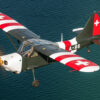
Scenic flight in an open cockpit: De Havilland Tiger Moth
An aircraft with which generations of pilots took their first steps in flying: With its characteristic biplane wings, open cockpit and distinctive appearance, the De Havilland Tiger Moth is one of the most famous training aircraft in aviation history. During the Second World War, it played a central role in the training of thousands of pilots of the Royal Air Force and its allied air forces.
A flight in a Tiger Moth is far more than an ordinary sightseeing flight. From Podhořany airfield, you'll experience aviation in its purest form. In the open cockpit, you'll feel the wind in your face, hear the engine, and experience every movement of the aircraft firsthand. And you're not flying in a replica, but in a genuine Tiger Moth with a history of service in the Royal Air Force during the Second World War.
You will be accompanied by a highly qualified team of experienced professional pilots, flight instructors, and warbird pilots with extensive experience on historic aircraft. Whether you are an aviation enthusiast or looking for an extraordinary experience, this flight combines authentic aviation history with the unique feeling of flying through the sky in an open biplane.
Flight characteristics De Havilland Tiger Moth
5 reasons for your Tiger Moth flight in Podhořany
Flying in a true legend
The de Havilland Tiger Moth is one of the most famous training aircraft in aviation history. During the Second World War, the British biplane was used in large numbers to train aspiring pilots of the Royal Air Force and its allied air forces. Generations of pilots completed their first flying lessons on the Tiger Moth before moving on to more powerful operational aircraft. Climb into the open cockpit of a genuine former RAF Tiger Moth and experience a piece of aviation history as the pilots of that era did.
Open cockpit & pure flying feeling
The unmistakable sound of the engine, the wind in your face in the open cockpit, and the immediate connection to the elements: in the De Havilland Tiger Moth, you experience flying in its purest form. Every turn, every movement of the aircraft, and every change in the wind is felt instantly, providing an authentic flying experience, just as generations of pilots have experienced it during their training.
Flying can be this immediate.
In the Tiger Moth, you experience flight with virtually no distance between you, the aircraft, and your surroundings. In the open cockpit, you feel the wind, experience every turn directly, and simultaneously enjoy the unobstructed view of the landscape below. It is precisely this close connection to the elements that makes a flight in the Tiger Moth an experience distinctly different from a sightseeing flight in a modern, enclosed aircraft.
Breathtaking scenery
From Podhořany airfield, you'll discover the diverse landscape of East Bohemia from a truly unique perspective. In the open cockpit of the Tiger Moth, you'll enjoy an almost unobstructed view of fields, forests, small villages, and the expansive countryside below. The relatively leisurely cruising speed allows ample time to savor the scenery and consciously take in your surroundings – a setting that perfectly complements the original character of this historic biplane.
Personal care & unforgettable memories
Experienced pilots, personalized service, and the team's passion for historic aircraft make your flight a truly special experience. From ground preparation to the actual flight in the open cockpit, you'll experience the Tiger Moth up close and immerse yourself in the world of classic aviation. An authentic flying experience that brings the history of this legendary biplane to life and will remain a lasting memory.
The de Havilland Tiger Moth is one of the most famous training aircraft in aviation history. During the Second World War, the British biplane was used in large numbers to train aspiring pilots of the Royal Air Force and its allied air forces. Generations of pilots completed their first flying lessons on the Tiger Moth before moving on to more powerful operational aircraft. Climb into the open cockpit of a genuine former RAF Tiger Moth and experience a piece of aviation history as the pilots of that era did.
The unmistakable sound of the engine, the wind in your face in the open cockpit, and the immediate connection to the elements: in the De Havilland Tiger Moth, you experience flying in its purest form. Every turn, every movement of the aircraft, and every change in the wind is felt instantly, providing an authentic flying experience, just as generations of pilots have experienced it during their training.
In the Tiger Moth, you experience flight with virtually no distance between you, the aircraft, and your surroundings. In the open cockpit, you feel the wind, experience every turn directly, and simultaneously enjoy the unobstructed view of the landscape below. It is precisely this close connection to the elements that makes a flight in the Tiger Moth an experience distinctly different from a sightseeing flight in a modern, enclosed aircraft.
From Podhořany airfield, you'll discover the diverse landscape of East Bohemia from a truly unique perspective. In the open cockpit of the Tiger Moth, you'll enjoy an almost unobstructed view of fields, forests, small villages, and the expansive countryside below. The relatively leisurely cruising speed allows ample time to savor the scenery and consciously take in your surroundings – a setting that perfectly complements the original character of this historic biplane.
Experienced pilots, personalized service, and the team's passion for historic aircraft make your flight a truly special experience. From ground preparation to the actual flight in the open cockpit, you'll experience the Tiger Moth up close and immerse yourself in the world of classic aviation. An authentic flying experience that brings the history of this legendary biplane to life and will remain a lasting memory.
Customer voice

The sound of the engine is simply amazing! It was a lot of fun.
Questions & Answers about the Tiger Moth Flight
When do flights take place?
Flights with the De Havilland Tiger Moth take place by individual appointment and subject to suitable weather conditions. Flights are particularly enjoyable on warmer days with temperatures of around 15°C and above. Flights cannot take place in strong winds, rain, fog, or other unsuitable weather conditions. In this case, the flight will be rescheduled accordingly.
Where are we flying to?
The scenic flight departs from Podhořany airfield and takes you over the diverse landscape of the surrounding region. During the approximately 25-minute flight, you'll experience fields, forests, small villages, and the expansive scenery of East Bohemia from the open cockpit of a Tiger Moth. The exact route depends on current weather conditions and flying conditions.
What is the process?
You will first be greeted by our experienced team at Podhořany airfield and given a close-up look at the De Havilland Tiger Moth. A short briefing will provide you with essential information about the aircraft, the flight procedure, and the upcoming scenic flight. If you wish, you can also try on historical aviation equipment such as a flying helmet, goggles, and boots. Afterward, you will take your seat in the open cockpit and embark on your approximately 25-minute flight over the East Bohemian landscape. After landing, there will be ample time for photos, questions, and a personal chat with the pilot.
How long does it take in total?
In addition to the actual flight time, please allow ample time for the entire experience. Besides the briefing, preparation, and the approximately 25-minute flight, there will be time for photos, questions, and a personal exchange with the pilot. Furthermore, you will have the opportunity to discover the historic aircraft of RAF Station Czechoslovakia up close.
Is aerobatics performed with the Tiger Moth?
During the scenic flight, more dynamic turns and maneuvers can be included upon request. However, complex aerobatic maneuvers are not performed. The experienced pilot will tailor the flight to your wishes, your personal comfort, and the prevailing flight conditions.
Can friends or family come to the airfield?
Of course! Your companions are very welcome at Podhořany Airfield and can witness the preparations, takeoff, and landing of the Tiger Moth. During your flight, you will also have the opportunity to discover the historic aircraft of RAF Station Czechoslovakia up close and observe the activity at the airfield.
Can I take photos or videos?
Of course, you are welcome to take photos and videos before and after the flight. Personal photos and videos are also generally permitted during the flight, provided this has been agreed upon with the pilot and does not compromise the safe conduct of the flight. This way, you can also capture your experience in the open cockpit of the Tiger Moth in photographs.
Who is my pilot?
The flights are conducted by a highly experienced team of professional pilots, flight instructors, and pilots with extensive experience on historic aircraft. The team includes, among others, Andrej Cepko, a professional flight instructor and pilot with experience on the Tiger Moth and other historic aircraft, and Ivo Kardoš, a former JAS 39 Gripen pilot and display pilot of the Czech Air Force.
Richard Santus, founder of RAF Station Czechoslovakia, is also a professional pilot with many years of experience flying historic aircraft. All pilots employed are familiar with the specific requirements of these classic planes and ensure a professionally executed and personalized flying experience.
What is the story behind the Tiger Moth?
Two historic De Havilland Tiger Moth Mk.II aircraft are available for the sightseeing flights; both were actually used by the Royal Air Force during the Second World War.
The Tiger Moth N9503 was built in 1939 and acquired by the Royal Air Force in December of that year. During the Second World War, it served at No. 4 Elementary Flying Training School in Brough, where it was used for the basic training of aspiring military pilots. After the war, N9503 embarked on a long civilian career, even serving for a time as an agricultural aircraft. Following a comprehensive restoration, it returned to the air in 2016 and has been based in Podhořany since 2017.
The second Tiger Moth, R5246, was built in 1940 and delivered to the Royal Air Force on April 26, 1940. From May 1942, it was assigned to No. 3 Elementary Flying Training School. This unit holds particular historical significance for RAF Station Czechoslovakia, as numerous Czechoslovakian pilots also completed their flight training there during the war. Following its restoration, R5246 flew again in 2010 and arrived in Podhořany in 2018.
These two aircraft are not modern replicas in historical colors, but genuine former RAF Tiger Moths with a history dating back to the Second World War. A sightseeing flight will therefore allow you to experience an aircraft type on which generations of aspiring RAF pilots took their first steps towards becoming military pilots, in two aircraft that were themselves part of this history.
Can I find out more about the De Havilland Tiger Moth?
The De Havilland DH.82 Tiger Moth is one of the most famous training aircraft in aviation history. Developed in the early 1930s from earlier De Havilland designs, it first flew in 1931. With its classic biplane design, two open cockpits, and docile flight characteristics, it was ideally suited for training aspiring pilots.
The Tiger Moth achieved its greatest importance during the Second World War. It became the Royal Air Force's primary training aircraft and was also used by numerous other Commonwealth air forces. Thousands of aspiring military pilots learned the basics of flying on this aircraft before progressing to more powerful training planes and eventually to operational aircraft.
The Tiger Moth Mk.II is powered by an air-cooled De Havilland Gipsy Major four-cylinder inline engine producing around 130 hp. Compared to modern aircraft, its technical systems are remarkably simple. This reduction to the essentials, combined with the open cockpit and direct controls, provides a particularly authentic flying experience.
The Tiger Moth was not only used for simple circuits, however. Pilot training also included navigation, formation flying, and advanced maneuvers. In this way, the relatively simple training aircraft prepared its pilots for the significantly more powerful aircraft they would later fly.
Today, the Tiger Moth is one of the most famous airworthy vintage aircraft in the world. Its distinctive appearance, the sound of the Gipsy Major engine, and the open cockpit still convey a direct impression of what pilot training must have felt like in the 1930s and 1940s.
What is the story behind these Tiger Moths?
Two original De Havilland Tiger Moth Mk.II aircraft, N9503 and R5246, are available for the sightseeing flights; their history dates back to the Second World War. Both aircraft actually served with the Royal Air Force and were used to train aspiring pilots.
N9503 was built in 1939 and acquired by the Royal Air Force in December of that year. It was assigned to No. 4 Elementary Flying Training School in Brough and spent the Second World War there. After its military career, it was used for civilian purposes and even temporarily converted into an agricultural aircraft. After several decades and various owners, N9503 underwent a comprehensive restoration. In May 2016, it returned to the air and has been based in Podhořany since 2017.
R5246 was built in 1940 and delivered to the Royal Air Force on April 26th of that year. From May 1942, it served with No. 3 Elementary Flying Training School. This unit has a special connection to Czechoslovakian aviation history, as numerous Czechoslovakian pilots were trained there during the Second World War. After its subsequent restoration, R5246 returned to the air in 2010 and arrived in Podhořany in 2018.
Today, both aircraft are maintained and flown by RAF Station Czechoslovakia. Therefore, on your sightseeing flight, you will not be flying a replica, but a genuine former RAF Tiger Moth, which was used to train pilots more than 80 years ago. This offers a rare opportunity not only to see an authentic piece of aviation history up close, but also to experience it in the air.
Tell me more about the manufacturer De Havilland
De Havilland is one of the most important names in British aviation history. Founded in 1920 by aircraft designer and aviation pioneer Geoffrey de Havilland, the company developed over the following decades into one of Britain's best-known aircraft manufacturers, producing light sport and training aircraft, airliners, and some of the most remarkable military aircraft of their time.
As early as the 1920s and 1930s, De Havilland made a name for itself with an entire family of light aircraft. Planes like the DH.60 Moth contributed significantly to making private and sport flying more popular in Great Britain and beyond. The DH.82 Tiger Moth also emerged from this successful Moth family in the early 1930s.
The Tiger Moth became one of the most important training aircraft of its era. Its docile flight characteristics, robust construction, and relatively simple technology made it ideal for pilot training. During the Second World War, thousands of aspiring pilots of the Royal Air Force and other Allied air forces were trained on the Tiger Moth. De Havilland thus played a vital role in training an entire generation of military pilots.
During World War II, de Havilland developed the DH.98 Mosquito, one of the most extraordinary combat aircraft of its time. The twin-engine plane, constructed largely of wood, combined high speed with long range and was used as a bomber, reconnaissance aircraft, night fighter, and fighter-bomber, among other roles. The Mosquito thus became a striking example of the company's innovative strength.
Even after the war, De Havilland remained a technological pioneer. With the DH.106 Comet, the company launched the world's first commercially operated jet airliner into regular passenger service in 1952. Although early Comet versions suffered serious technical setbacks, their investigation and further development provided important insights for the design of later airliners.
De Havilland also developed numerous other well-known aircraft, including the Vampire and Venom as early British jet fighters. In 1960, the company merged with Hawker Siddeley, thus ending the De Havilland name as an independent British aircraft manufacturer. However, its influence on aviation is still evident today.
The two Tiger Moths, N9503 and R5246, are therefore not just historic training aircraft from the Second World War. They are flying testaments to a manufacturer whose developments shaped British aviation from open biplanes to legendary military aircraft and into the age of jet travel.
Flights with the De Havilland Tiger Moth take place by individual appointment and subject to suitable weather conditions. Flights are particularly enjoyable on warmer days with temperatures of around 15°C and above. Flights cannot take place in strong winds, rain, fog, or other unsuitable weather conditions. In this case, the flight will be rescheduled accordingly.
The scenic flight departs from Podhořany airfield and takes you over the diverse landscape of the surrounding region. During the approximately 25-minute flight, you'll experience fields, forests, small villages, and the expansive scenery of East Bohemia from the open cockpit of a Tiger Moth. The exact route depends on current weather conditions and flying conditions.
You will first be greeted by our experienced team at Podhořany airfield and given a close-up look at the De Havilland Tiger Moth. A short briefing will provide you with essential information about the aircraft, the flight procedure, and the upcoming scenic flight. If you wish, you can also try on historical aviation equipment such as a flying helmet, goggles, and boots. Afterward, you will take your seat in the open cockpit and embark on your approximately 25-minute flight over the East Bohemian landscape. After landing, there will be ample time for photos, questions, and a personal chat with the pilot.
In addition to the actual flight time, please allow ample time for the entire experience. Besides the briefing, preparation, and the approximately 25-minute flight, there will be time for photos, questions, and a personal exchange with the pilot. Furthermore, you will have the opportunity to discover the historic aircraft of RAF Station Czechoslovakia up close.
During the scenic flight, more dynamic turns and maneuvers can be included upon request. However, complex aerobatic maneuvers are not performed. The experienced pilot will tailor the flight to your wishes, your personal comfort, and the prevailing flight conditions.
Of course! Your companions are very welcome at Podhořany Airfield and can witness the preparations, takeoff, and landing of the Tiger Moth. During your flight, you will also have the opportunity to discover the historic aircraft of RAF Station Czechoslovakia up close and observe the activity at the airfield.
Of course, you are welcome to take photos and videos before and after the flight. Personal photos and videos are also generally permitted during the flight, provided this has been agreed upon with the pilot and does not compromise the safe conduct of the flight. This way, you can also capture your experience in the open cockpit of the Tiger Moth in photographs.
The flights are conducted by a highly experienced team of professional pilots, flight instructors, and pilots with extensive experience on historic aircraft. The team includes, among others, Andrej Cepko, a professional flight instructor and pilot with experience on the Tiger Moth and other historic aircraft, and Ivo Kardoš, a former JAS 39 Gripen pilot and display pilot of the Czech Air Force.
Richard Santus, founder of RAF Station Czechoslovakia, is also a professional pilot with many years of experience flying historic aircraft. All pilots employed are familiar with the specific requirements of these classic planes and ensure a professionally executed and personalized flying experience.
Two historic De Havilland Tiger Moth Mk.II aircraft are available for the sightseeing flights; both were actually used by the Royal Air Force during the Second World War.
The Tiger Moth N9503 was built in 1939 and acquired by the Royal Air Force in December of that year. During the Second World War, it served at No. 4 Elementary Flying Training School in Brough, where it was used for the basic training of aspiring military pilots. After the war, N9503 embarked on a long civilian career, even serving for a time as an agricultural aircraft. Following a comprehensive restoration, it returned to the air in 2016 and has been based in Podhořany since 2017.
The second Tiger Moth, R5246, was built in 1940 and delivered to the Royal Air Force on April 26, 1940. From May 1942, it was assigned to No. 3 Elementary Flying Training School. This unit holds particular historical significance for RAF Station Czechoslovakia, as numerous Czechoslovakian pilots also completed their flight training there during the war. Following its restoration, R5246 flew again in 2010 and arrived in Podhořany in 2018.
These two aircraft are not modern replicas in historical colors, but genuine former RAF Tiger Moths with a history dating back to the Second World War. A sightseeing flight will therefore allow you to experience an aircraft type on which generations of aspiring RAF pilots took their first steps towards becoming military pilots, in two aircraft that were themselves part of this history.
The De Havilland DH.82 Tiger Moth is one of the most famous training aircraft in aviation history. Developed in the early 1930s from earlier De Havilland designs, it first flew in 1931. With its classic biplane design, two open cockpits, and docile flight characteristics, it was ideally suited for training aspiring pilots.
The Tiger Moth achieved its greatest importance during the Second World War. It became the Royal Air Force's primary training aircraft and was also used by numerous other Commonwealth air forces. Thousands of aspiring military pilots learned the basics of flying on this aircraft before progressing to more powerful training planes and eventually to operational aircraft.
The Tiger Moth Mk.II is powered by an air-cooled De Havilland Gipsy Major four-cylinder inline engine producing around 130 hp. Compared to modern aircraft, its technical systems are remarkably simple. This reduction to the essentials, combined with the open cockpit and direct controls, provides a particularly authentic flying experience.
The Tiger Moth was not only used for simple circuits, however. Pilot training also included navigation, formation flying, and advanced maneuvers. In this way, the relatively simple training aircraft prepared its pilots for the significantly more powerful aircraft they would later fly.
Today, the Tiger Moth is one of the most famous airworthy vintage aircraft in the world. Its distinctive appearance, the sound of the Gipsy Major engine, and the open cockpit still convey a direct impression of what pilot training must have felt like in the 1930s and 1940s.
Two original De Havilland Tiger Moth Mk.II aircraft, N9503 and R5246, are available for the sightseeing flights; their history dates back to the Second World War. Both aircraft actually served with the Royal Air Force and were used to train aspiring pilots.
N9503 was built in 1939 and acquired by the Royal Air Force in December of that year. It was assigned to No. 4 Elementary Flying Training School in Brough and spent the Second World War there. After its military career, it was used for civilian purposes and even temporarily converted into an agricultural aircraft. After several decades and various owners, N9503 underwent a comprehensive restoration. In May 2016, it returned to the air and has been based in Podhořany since 2017.
R5246 was built in 1940 and delivered to the Royal Air Force on April 26th of that year. From May 1942, it served with No. 3 Elementary Flying Training School. This unit has a special connection to Czechoslovakian aviation history, as numerous Czechoslovakian pilots were trained there during the Second World War. After its subsequent restoration, R5246 returned to the air in 2010 and arrived in Podhořany in 2018.
Today, both aircraft are maintained and flown by RAF Station Czechoslovakia. Therefore, on your sightseeing flight, you will not be flying a replica, but a genuine former RAF Tiger Moth, which was used to train pilots more than 80 years ago. This offers a rare opportunity not only to see an authentic piece of aviation history up close, but also to experience it in the air.
De Havilland is one of the most important names in British aviation history. Founded in 1920 by aircraft designer and aviation pioneer Geoffrey de Havilland, the company developed over the following decades into one of Britain's best-known aircraft manufacturers, producing light sport and training aircraft, airliners, and some of the most remarkable military aircraft of their time.
As early as the 1920s and 1930s, De Havilland made a name for itself with an entire family of light aircraft. Planes like the DH.60 Moth contributed significantly to making private and sport flying more popular in Great Britain and beyond. The DH.82 Tiger Moth also emerged from this successful Moth family in the early 1930s.
The Tiger Moth became one of the most important training aircraft of its era. Its docile flight characteristics, robust construction, and relatively simple technology made it ideal for pilot training. During the Second World War, thousands of aspiring pilots of the Royal Air Force and other Allied air forces were trained on the Tiger Moth. De Havilland thus played a vital role in training an entire generation of military pilots.
During World War II, de Havilland developed the DH.98 Mosquito, one of the most extraordinary combat aircraft of its time. The twin-engine plane, constructed largely of wood, combined high speed with long range and was used as a bomber, reconnaissance aircraft, night fighter, and fighter-bomber, among other roles. The Mosquito thus became a striking example of the company's innovative strength.
Even after the war, De Havilland remained a technological pioneer. With the DH.106 Comet, the company launched the world's first commercially operated jet airliner into regular passenger service in 1952. Although early Comet versions suffered serious technical setbacks, their investigation and further development provided important insights for the design of later airliners.
De Havilland also developed numerous other well-known aircraft, including the Vampire and Venom as early British jet fighters. In 1960, the company merged with Hawker Siddeley, thus ending the De Havilland name as an independent British aircraft manufacturer. However, its influence on aviation is still evident today.
The two Tiger Moths, N9503 and R5246, are therefore not just historic training aircraft from the Second World War. They are flying testaments to a manufacturer whose developments shaped British aviation from open biplanes to legendary military aircraft and into the age of jet travel.
More customer testimonials
Clearly the best way to spend a Sunday afternoon. Now let's move on to the Mustang!
Absolutely breathtaking! I felt like a bird flying over the Alps.

I always knew this was Pierre's dream. Thank you for making this possible!
| airport | |
|---|---|
| Flight duration | 25 minutes, 25 minutes. 2 aircraft in formation., 25 minutes. 3 aircraft in formation. |
| Aircraft type | |
| status | |
| Availability | Tuesday, Thursday, Friday, Wednesday, Monday, Saturday, Sunday |
Related products


Highlights


Habsheim


Bremgarten


Biplane


acrobatics


Historical


